
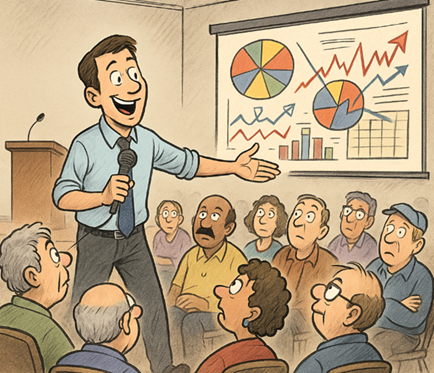
I’m there to speak to union members about Medicaid. Between the podium and the audience is ten yards of open space. Like a first down marker for awkwardness.
The last speaker stayed anchored at the podium. I yank out the mic and walk into the crowd.
Then I do what any serious policy analyst would do: I open with a question about dairy packaging.
“Why is milk sold in rectangular containers while soda comes in round ones?”
After a few crowd guesses—including “Big Dairy”—I pivot to the real topic: taxes and Medicaid.
Then I add:
“I don’t just research state budgets—I study how to talk about them. And what focus groups tell us is: no charts, no numbers, no graphs. That stuff loses people.”
(Pause. Advance slide revealing three pie charts, four arrows, and a data table having a panic attack.)
“So… as you can see, I haven’t figured out how to do that yet.”
Boom. Second laugh. Now we’re rolling. I’ve got momentum. Despite the subject matter being less thrilling than a cold sponge bath in a hospital billing office.
How did I learn this?
From stand-up comedy.
Here’s something rookie comics don’t realize: when you walk onstage, the audience doesn’t know who you are, what your deal is, or why you just made a joke about squirrels unionizing.
As I learned from Mike’s book Fine-Tuning Your Funny Muscle, this isn’t Season 2 of a sitcom where everyone knows your character and expects their signature hijinks—like the dad who only speaks in Civil War reenactment quotes.
This is the pilot episode. Every time.
But here’s the trick: you can train the audience.
By setting tone fast—what to expect, when to laugh, how to engage. Clap here. Laugh there. Interact. Lean in. Don’t be bored.
This works in all kinds of public speaking: classrooms, town halls, community forums—any room where there’s a mic and someone’s Aunt Barbara, I learned, who might ask if Medicaid covers goat acupuncture.
That’s why I open with something unexpected. It resets the room’s expectations.
I could be prepping a 30-minute lecture on property taxes and fire department funding, and I’ll start with the question about milk packaging.
The room perks up. People laugh, guess, engage. And suddenly we’ve shifted from passive reception to active weird-brain mode.
Because when people hear “policy talk” from an economist, they assume they’ll be stuck listening to a voice like a dial-up modem trying to explain oatmeal to an actuary. And not even good oatmeal. (“I say, Sir! This porridge tastes like an infantry ration left damp since the Siege of Vicksburg!”)
If I don’t snap them out of that mindset quickly, I lose them—to Instagram or quietly wondering if they could escape through the HVAC system.
And the room set-up matters, too.
Comedy clubs are built for laughter: low ceilings, packed chairs, and audiences smushed together like they’re sharing body heat and nacho platters. Why? Because laughter is contagious. Like yawns. Or Civil War roleplay voices. (“I Say, Sir!”)
So I recreate that: I move into the audience. I roam. Mic in hand. Eye Contact. I eliminate the “comedy dead zone” between me and the crowd. Because when you speak with a gap between you and the audience, the jokes drift upward and get lodged in the light fixtures.
This is why I never speak from behind a podium, unless it’s to hide from someone who just asked about goat acupuncture. It sets the tone. It humanizes you. It lets them know, “Hey, I’m just like you—except I talk with my hands and overshare about dairy packaging.”
Stand-up comedy didn’t just make me funnier—it made me better at teaching, presenting, and leading meetings.Because whether you’re talking about Medicaid or tariffs, your job is the same: set the tone, steer the energy, and keep the audience with you. Stand-up taught me to skip the slow warm-up, ditch the dead zone, and lead with something weird, funny, or oddly dairy-related.
And yes, there’s a real answer to the milk thing: Milk goes in rectangular cartons because it has to be refrigerated, and shelf space in a fridge is more expensive than shelf space in the soda aisle. So you save space with rectangles. Soda doesn’t need to be cold, so it gets to be round and ergonomic.
Or in the parlance of Civil War Dad, “I say, Sir! One must be the crate or be the cannonball.”

By Chris Stiffler
Author of Economics In-Other-Words
Get your FREE copy of The Business of Comedy!
Includes:
- How Comedians are 5-Tool Players
- How to Attract a Following
- How to Get Bookings
- How to Create Multiple Income Streams
- Manager vs Agent
- And More!
This blog post is worth the read – trust us!